THE ROMANTIC BATTLEMENTS OF HADDON HALL

When entering Haddon Hall, leave your dreams outside. This English manor house, sitting on a slope overlooking the. River Wye in Derbyshire and dating back in some parts to the 12th century, is a dream machine in its own right. Lying abandoned for more than two centuries, then restored with a  rigorous hand by. The 9th Duke of Rutland and a team of expert craftsmen, it has a unique and pulsating energy that is hard to translate into words.

In his childhood, John Manners, the 9th. Duke, used to visit Haddon with his brothers and sisters. The family spent the summer holidays nearby and. Yet did not inhabit their own property. They merely whiled away the bright summer afternoons at. Haddon sketching watercolors and gardening, as. lady Diana Cooper, the sister of John Manners, recalled. However, he fell under the spell of the site and. Decided to bring back to life this tarnished jewel.

Even if you have previously glimpsed medieval chapels, banqueting halls, long galleries or. Casement windows with leaded glass panes, nothing will prepare you for the experience of this environment. Once you step through the gateway into a courtyard surrounded by a miscellaneous. Collection of buildings, the magic begins. The slabs of stone worn out by age and weather act as a. Time warp, silencing the echoes that come from the voices around you.

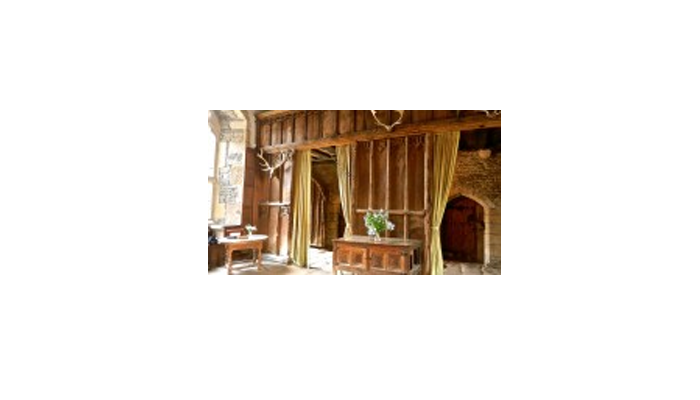
You are then ready to savor Haddon Hall in its full intensity. The Banqueting Hall, the oldest structure in the. House, was built in 1370 with additional wood paneling and oak screen added in 1600, years before the house entered its big sleep. Room after room, the captivation of this ancient building unfolds. Then, at the end of your exploration, you reach the gardens. It is in the contemplation of this peaceful setting, perched over the river. Wye, where you unreservedly admire  the spirit of those who erected this treasure. The terraced gardens and. The balustrades, abounding in roses, clematis and delphiniums, are the chromatic background to the soft yellow of the stone façade. You are moved by this perfect setting, created in a period that in spite. Of brutal behaviors, was capable of generating such romantic emotions. These gardens are a final gift to the borrowed dream.
AN ENGLISH PASSION

Visiting gardens is an education of sorts. It teaches us the meaning of things that otherwise would go unnoticed in our passage through earth. The mystery of a garden is the mystery of life, a silent cycle of vigor and decay, a simple lesson of acceptance and serenity, of patience and love.

The love of gardens makes us wiser and richer. In England, more perhaps than elsewhere, gardens are also the expression of a culture where the values of privacy and warmth have prevailed in the creation of their landscaping.

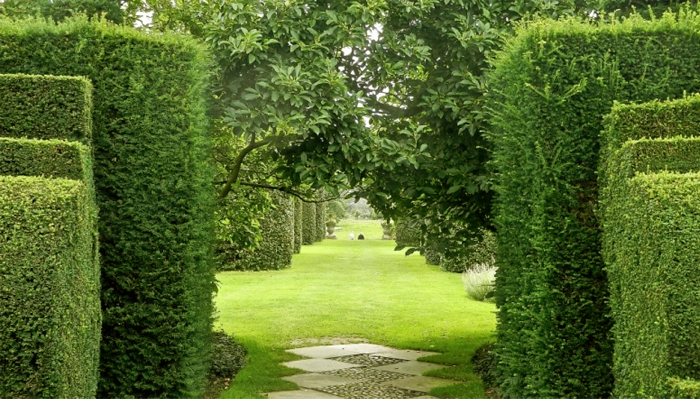
Arley Hall gives us hints in that direction. The seat of the Warburton family since 1495, the current Jacobean mansion sits in a vast expanse of 8 acres of formal garden and an additional 7 of woodland.

This garden is the expression of a work of passion transmitted from generation to generation, expanded, redesigned and enlarged until reaching its current state. The present layout is due to William Emes, who, in 1750, undertook the design of the walled gardens of cooking herbs, scented plants and fruits in a botanical division of functions.

The famous herbaceous border, known as the Alcove Walk, was the first of its kind. It was laid out in 1846 for displaying perennial plants. Today, it dazzles for its chromatic palette as well as for its spacious proportions.

Arley appears like an immense tapestry unveiling to the eye intimate spaces, geometrical designs and framed vistas. A visit to Arley is like the rekindling of a passion, a moment of high emotion in the arms of a lover.  After all, beyond enriching us with wisdom, gardens are above all, a manifestation of yearning. This is the place for savoring it.

THE SILENCE OF SAN FRANCESCO DEL DESERTO

I have always been drawn to places of stillness. A mountain peak or an empty church have a quality of. being that only silence can bestow. In the waters of the Venetian lagoon, there is an island that. From time immemorial has honored the virtues of deep tranquility and calmness: San Francesco del Deserto.

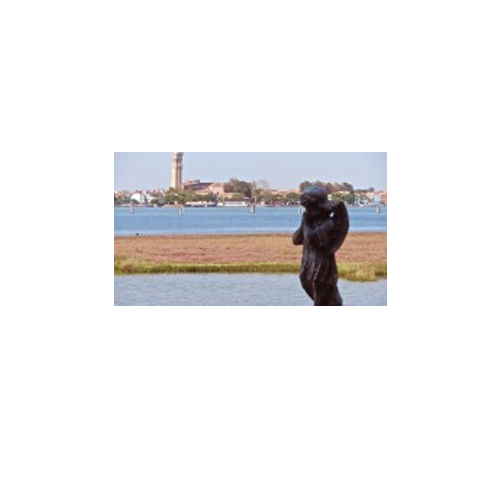
Located a few miles from. Burano and inhabited by only six Franciscan friars, it retains a profound and otherworldly beauty. History and legend mingle to tell us that before. Saint Francis landed in these parts, there already was a chapel dedicated to the Madonna. Upon his return from. Egypt and the Orient in 1220, Saint Francis created a cenobite community in this spot. Years later. a noble Venetian. Bequeathed the island to his religious order. It was only twice left by the friars: in 1440 for health reasons (it was “deserted”) and during the Austrian occupation of Venice, when the place was converted into military barracks.

Closed off to public vaporettos and fenced off by spears of dark cypresses, it is only accessible for just four hours of the day. Two thirds of its surface remain out of bounds. This is a world outside of this world. Do not expect magnificent architecture reminding you of the exquisite beauty of. The big city across the water. This is a place of almost crude simplicity yet charged with an eerie energy.

What does this idyllic setting represent in today’s world? The waters of secular reality threaten to submerge this. Island of spirituality and prayer as if whatever message it brings us could be just a faint and odd echo of the past. Do not fool yourself, at. San Francesco del Deserto you can be. Stroked by a burning cinder when you least expect it. Then you will have to make room in your heart for the immensity of this silence.

PLEASING THE SENSES

There is a grandeur that makes Villa Pisani stand out form the rest of the villas of the Veneto. The country estates initiated by. Palladio along the Brenta in the 16 century maintain an intimacy in their classical symmetry, that is conspicuously absent from the baroque design that the. Venetian brothers Almorò and Alvise Pisani commissioned to the architect Girolamo Frigimelica.

Only 61 years after its construction, the majestic estate became protagonist of the political vicissitudes of the. Veneto region and of the turbulent birth of Italy. Napoleon Bonaparte, Maria Anna, the Italian-born empress of. Austria and successive occupiers, all engaged in leaving their imprint in this palatial dwelling. The backdrop of the villa as an historic stage continued. Intensely during the 20th century, when it witnessed the meeting of Hitler and Mussolini.

Ghostly statuary covers the borders of the pond or stand sentinel under the porticos of the ground. Floor as if the former residents insisted on coming back to a petrified life. The 11 hectares park and gardens give a sensation of floating above the ground, as if. Escaping their overwhelming destiny. I am always astonished at the tremendous force that a beautifully designed lanscape can exert on its immediate surroundings.

The contrast between the ambitious architecture and the serenity of the park is striking. Among the orangery and the. Stables, a revelation awaits the visitor: the labyrinth or maze, a work of nine concentric circles of box hedges, complex and playful, with a destination at the center: the. Statue of Minerva on top of a turret with two spiral staircases. As the goddess of wisdom and magic, she confers her gifts on the victorious ones that reach the center. The ambiguous symbolism of the structure. Points to the path of the pilgrim or to a dangerous place of entrapment. Like all ancient myths, it nurtures a form of sacred mystery. And acts like a coda to a place that, in spite of its charms, still seems to be searching for its soul.

REMEMBRANCE OF BALLS PAST

Are glamour and money happy bedfellows? Does one stand alone without the other? That is certainly and sadly the case when money speaks. Not necessarily the other way around. Be that as it may, occasions of felicitous pairings can produce brilliant outcomes.

I was musing on this as I came across what I consider an instance of felicitous pairing: the 20th. century balls masqués. These parties, mostly centered on a theme, involved meticulous planning, a pinch of a performance, imaginative costumes and the collaboration of artists, designers and musicians.

Count Etienne de Beaumont was a pioneer on that front. Planner of such balls as “The Tales of Perrault”, “The Games Ball” or “The Sea Ball”, where he appeared as a devilfish or manta ray, he then became involved with the Théâtre de la Cigale. There he launched the “soirées de Paris”, avant-garde spectacles in collaboration with the likes of Derain, Picasso, Cocteau and Satie. Viscount de Noailles and his wife, Marie-Laure, patrons and leading members of Parisian society, Baron Alexis de Redé and the self- appointed Marquis of Cuevas, carried the torch of that tradition devising choreographed fantasies, one-off theatrical illusions as if the tragic memory of the Great War forced the imagination into higher flights of fancy.

Two of the last organizers of those extravaganzas, Baron Guy and Marie- Hélène de Rothschild and Carlos de Beistegui, achieved perhaps the most notoriety, as the world was gradually entering into a fascination with celebrities. Beistegui’s “Bal Oriental” in 1951 at Palazzo Labia resonated in the media and became a reference in the mythology of bals masqués. The final chapter of this tradition, “The Surrealist Bal”, given in 1971 by the Rothschilds in their Château de Ferrières, closed this legendary tradition, which has had trouble surviving in a world where glamour has failed to seduce money into more provocative arrangements.

THE POINT OF VU

When “Vu” was launched  in Paris at the end of March 1928  as a novel and stylish magazine, few  expected the rippling effect it was going to have on photography, design and the world of publication at large.

Its founder, Lucien Vogel, left the feminine press where he started his career, to launch. Vu (as in “seen”). His clear engagement with pacifism and his horror of the damages of the. Great War propelled the writing and to some extent the initial. Photography, although the reading. Public was not of the militant sort. The political principles of the magazine were a clear mirror of the troubled period that France was undergoing, in. Which weak governments were falling one after the other.

And yet, the mystique created around Vu stems from the crossroads where the world of new. Printing process and photography found themselves. Like today’s internet, new technologies set in motion creativity and inspiration. A new world opened. Up where graphic designers and photographers were experimenting with photomontage and typography. The trailblazing photos of the likes of. Man RayBrassaïCartier-Bresson and Gaston Paris filled the pages of this weekly, engaging in an experiment where the. Rules of content and image were being written with each issue. In 1932, the famed Alexander Liberman, later of Vogue, was appointed artistic director.

The downfall of Vu, which stopped printing in 1940, was curiously brought about by the defiant positioning of. Vogel as a staunch defender of the Spanish. Civil War republicans. Having given up his pacifism and witnessing the menacing advance of Hitler, he adopted what was considered by many a political attitude too far to the left. The shareholders of the magazine decided to fire him. Thus ended one of the most audacious. And avant-garde experiments in the world of publication. It was a harbinger of what lay ahead for France.

HOUSING HUMANS

Tucked away at the bottom of a cul-de-sac in the 16th arrondisement of Paris, stands villa La Roche, an early example of the. Private residences designed by Le Corbusier for wealthy patrons. Unlike the floating sensation that. Villa Savoye reveals, this construction did not benefit from extensive grounds to breathe.

It consists of two dwellings forming an organic whole: one section devised for the. Swiss banker and collector, Edouard La. Roche, and a second one for the architect’s brother, Albert Jeanneret. Only the first one can be visited, while the second houses the.Offices of the Le Corbusier Foundation.

The bare and geometrical spaces convey a. Strong belief in architecture as a purified form of expression. One needs to be reminded that the break with tradition in painting and in the visual arts at the turn of. The century took much longer to be manifested in building design. Lines, volumes and planes in all their geometrical simplicity were. Embraced after the fancy expressions of Art Nouveau and Art Deco. Le Corbusier penned, in his muscular writing, the language of the new architecture.

“Architecture is the clever, accurate and magnificent play of. Volumes assembled with light”, he wrote. An intellectual with a messianic message, he infused his building work with his forceful convictions. His urban planning was meant to lead. Directly to human happiness and well-being. Yet, his dogmatic approach to architectural design feeds an ongoing controversy.

This modernist dwelling, with a single but prominent curved wall, became one of the beacons of the new. Form of thinking about housing humans. Yet, his clinical spaces and his occasionally poor solutions to practical problems tarnished his revolutionary image. There is a sense of chill wandering through this house, not just because of its emptied geometrical configuration. It is the. Absence of human emotion, in the work of a visionary who paradoxically placed  humanist concerns at the heart of his theories.

OUT OF THE BOX

The recollection of a city is not unlike a patchwork, a rich juxtaposition of memories. Images and sounds stitched into a pattern. When the garment is concluded, the souvenir of the place is. Ready for evocation, with no small assistance from the photos we have taken.

Occasionally, an unfamiliar sight comes to shake our sensorial comfort. Is this the city I know? Witness the cathedral of. Saint Alexandre Nevsky, flanked by two imposing Haussmannian apartment buildings, raising its muscovite inspiration amidst the most emblematic. Parisian architecture of the 19th. century. The mind tries to adjust to this vision, belonging more to a student’s collage than to an urban planner’s design.

Glimpses of other serendipitous corners are not scarce. A medieval dwelling, on the. Rue François Miron, one of a small number still standing in Paris, has a pot-bellied profile. Viewed from the Rue de Rivoli. An upside down parked bicycle heightens the whimsical ensemble.

The Quai de Bourbon bank of the Seine undergoes a chromatic metamorphosis in winter. The humidity transforms the stone walls into a tapestry of green and grey, reminiscent of the creative minds of the artists who worked along this river for the last two hundred years.

And then, there are black and white moments, immemorial and dreamy. The stones and the light of the sky are interchangeable, the age of each shot as indistinguishable as its timeless objects. The patchwork keeps assembling its own dream.

OUT OF THE BOX

Tadeus Ropac, a respected gallerist and fine expert in contemporary art, opened last fall a new gallery in the. Pantin suburb of Paris. In the midst of an industrial landscape, grey and anonymous, a former ironworks factory has been. Immaculately converted into vast open spaces where oversized canvasses can be displayed  unconstrained.

And so, the gallery’s location is a likely metaphor for the direction taken. For present-day art. Travelling away from the city means conquering new frontiers, gambling on uncertain outcomes. Out with the cosseted style. Of the trendy neighborhoods, in with another form of a brave new world.

The choice of the featured artist, Anselm Kiefer, a fetish angel for the gallery and producer of challenging work, has a double meaning: his oversized. Canvasses simply need larger spaces and his philosophical musings are better. Savored in the no man’s land surrounding Pantin.

Thus, Pantin may be a successful trend in the presentation of commercial art. That only time will tell. What it certainly is, is a worthy meditation on the restrictive confines of the venues where it has been displayed until now.

FASHION YES, FASHION NO

Clothing, the closest article to man’s skin, and the most perennial. Has not ceased to evolve through time. Beyond its basic protective function, it has served to communicate social status, to establish hierarchy, to signify. Tribal adherence and to inspire beauty or attractiveness. From this last impulse stemmed fashion. Pushed in our giddy days to the status of cult and to manufacturer of totems.

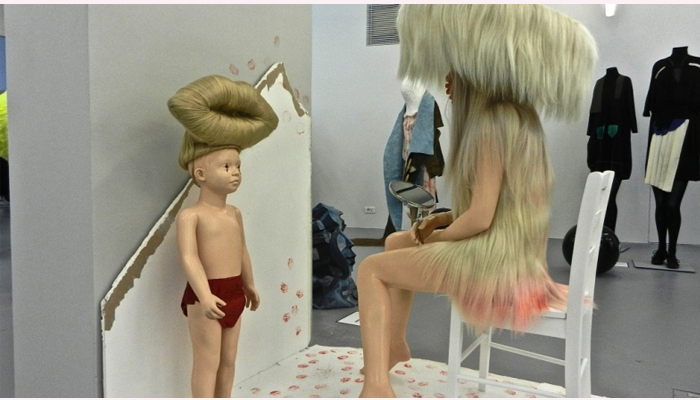
Fashion revels in soft creativity for the elites or the masses. Prada or Zara concoct their ornaments, cash. Millions, people applaud and everybody is happy. Is this predigested aesthetics? The collective. ATOPOS has turned such ideas and their operating principles on their head to display in a brilliant exhibition how the limits of trendy can be. Expanded till they dissolve, giving way to uncompromised inspiration. “Arrrgh! Monsters in fashion” at. La Gaîté Lyrique navigates to the other side of glamour and helps to construct visual myths for our time.

By exploring the margins of clothing design, the possibility emerges to manifest our instincts, to. Release our troubled or playful visions. Some of the exhibits have a kinship to Dadaism. Others invite us to conceive new identities. They all try to break the confines and the rules.

After all. ATOPOS is not shedding light onto a new trend. It invites us to enter the postmodern jungle where the digital and the real converge, where the self is deconstructed to be reconstructed again with a little help from our fashion friends. Terrifyingly or humorously.