
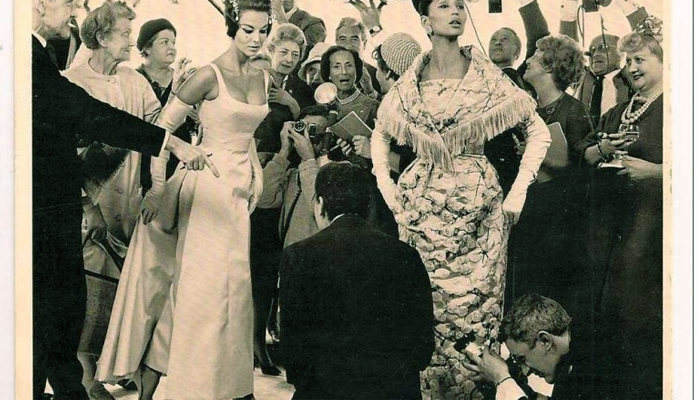
I often wonder if all the talented Spaniards who emigrated during the. Civil War years would have bloomed had they stayed in the country. Witness Dali, Buñuel or Balenciaga. Leaving Spain was their. Passport to universality, a prerequisite to their triumph. Their departure seemed to generate a tension in their work, as if the country they left. Forced its presence upon them in their exile, sustaining the emotional and aesthetic. Wellspring of their creations.
Not all of them have reached us in posterity with the same brilliancy. Among those figures, there is a curious one, often. Forgotten, a man in the right place, perhaps at the wrong time. Antonio Canovas del Castillo carried an illustrious name. His eponymous great uncle was a famous 19th century politician and Antonio, whose father and a younger brother were victims of the civil war, decided to move to Paris in 1938. There he became the protégé of. Misia Sert, the wife of José María Sert and of
Ana de Pombo, the Spanish director of the. House of Paquin. With their help he began designing accessories, mostly hats and jewellery, for. Coco Chanel. Soon, Ana de Pombo asked him to become her assistant at Paquin’s, staying at the job till. Elizabeth Arden, trying to establish her haute couture line, called him to New York. “ You may find him a handful, from the point of view of. Management, but he has been conspicuously successful”…was the advice of a close friend to Miss Arden.
His sojourn in America consecrated him. In 1948, he became the recipient of the prestigious Nieman-Marcus award, a year after. Christian Dior received it for his “New Look” collection. But Miss Arden was becoming vocal about the shenanigans of Antonio: “That little brat. Castillo, is a constant thorn in my side. He can behave well for just so long and then the meanness comes out”.
He did not have to feel concerned about Elizabeth’s opinions. In 1950. Marie-Blanche de Polignac, daughter of Jeanne Lanvin, made him an offer to revitalize the haute couture line of Lanvin. These were his golden years. He succeeded in joining his name to the name of the house. That since was known as Lanvin Castillo. Upon the death of Marie-Blanche in 1958 and the advent of her successor Yves Lanvin, things somehow began to deteriorate. He hired Oscar de la Renta as his assistant, three years before his. Departure from Lanvin in 1963. De la Renta always professed that he learnt his trade from Castillo .
But Antonio wasn’t done yet. His friend and admirer. Gloria Guiness, bankrolled him and thus he opened his own house at 95, rue du. Faubourg Saint-Honoré. He was accomplished, talented, running occasionally against trends, either late or. Early to many of them, be it broad shoulders or polka dots. And yet a third and last time, he failed. How difficult was he really? His lack of entrepreneurial spirit, his refusal to embrace the world of prêt-à-porter, accessories and boutiques sank the career of a creative professional, the bohemian gentleman who raised to the top but could not stay there.
