
CECIL’S SHANGRI-LA

CECIL’S SHANGRI-LA

He was seduced immediately. Ashcombe, a sleepy hollow on the boundaries of Dorset and Wiltshire, was an accident in the life of Cecil Beaton. Staying for a weekend with his friend. Edith Oliver in Wilton, he spoke of his longing for a small cottage in the country, a frequent remark uttered by city guests. Edith mentioned the casual discovery made by a friend of theirs, the sculptor. Stephen Tomlin, of a deserted house with a grotto in the downs. Uncertain of its exact location, the three of them decided to drive in its search.

After motoring blindly around, Tomlin recognized a rough path and the party charged down on foot to a distant cluster of trees. Among holy oaks, they caught a glimpse of the property. It was silent and neglected, long unlived in. As he later wrote in his memoir of the years at Ashcombe: “It was as if I had been touched on the head by some magic wand. Some people may grow to love their homes; my reaction was instantaneous. It was love at first sight, and from the moment that I stood under the archway, I knew this place was destined to be mine.”

Here, at play, is a moment of magic when a desire explodes in the heart at the sight of something or someone very special. All, then, appears possible. The longing creates a vision and. Cecil already saw in his mind what the house would look like.

At 26, still laboring a professional future and not financially strong, the idea sounded preposterous, especially to his family. He was already a budding manufacturer of worlds and a visionary magician. The cautionary advice did. Not prevent him from approaching the owner and agreeing a rent of £50 pounds per annum.

He proceeded to revamp the space and to bring in furniture acquired during his trips abroad. Succumbing to the decorative fashion of all white. The perfectly idyllic retreat, a resplendent paradise and a magnet to friends was thus created. Visitors came and went and as with so. Much of his oeuvre, it soon was wrapped in a certain mystique.

When the lease could not be renewed, he tore himself away from it with nostalgia and a sense of deep loss. Ashcombe became a literary memoir, a tribute to the love it gave him and his way of repaying it.

Did Madonna experience the same fascination when she decided to acquire the property in 2004? Perhaps she expected the enchantment of the place would be revealed to her.

It is unlikely she glimpsed any of it. Power and a large ego took her to the pages of Vogue magazine posing as a dignified chatelaine in the heavenly kingdom. Following her divorce from Guy Ritchie in 2008, the house passed to her ex-husband as part of the divorce settlement. I am quite certain. Ashcombe was not interested in repeating the love story it had with Cecil Beaton.
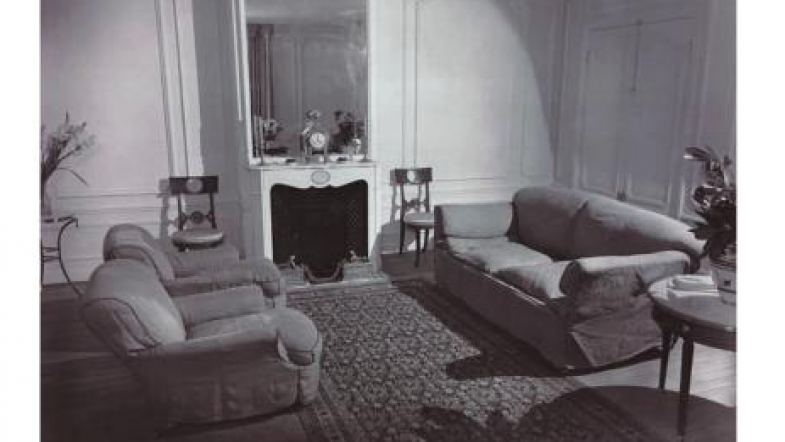
HOW SELF-EFFACING A TASTEMAKER CAN BE

Oscar Wilde’s epigram about simple pleasures being the last refuge of the complex, made me think, the first time I heard it, about Eugenia Huici. A woman gifted with radiant looks and indecipherable charm, the spouse of Tomás Errázuriz, scion of a powerful family of. Chilean politicians and wealthy landowners. She was destined to be famous for being herself, a far cry. From the shallowness of our culture of celebrities. In 1880, her young husband’s passion for painting and the presence of her. Brother-in-law as Chilean Consul in Paris, landed the couple in the.

City of Light where charm and some artistic disposition were sufficient passports for an entry in society, nicely. Accelerated if a degree of wealth was also involved. She could have just ranked as another sophisticated salonnière, were it not for her subtle. Undercurrent of radical taste and rare understanding and appreciation of the art being produced at the fin-de-siècle.

During a vacation in Venice, she befriended and was painted by. John Singer Sargent. Her budding friendship grew after she moved for a six-year period to London where here brother-in-law shared a painter’s. Studio with the master only a few doors down from her home in Chelsea. By then, she had already warmed up in Paris to a refined circle of artists. Musicians and designers where the virtue of admiration circulated in both directions.

It was surrounded by Picasso, Boldini. Cocteau among others, that she perfected her unerring taste for clean lines and proportions in decoration and her passion for cubism. Soon, her remarks on how rooms should be furnished. What elements of style were essential and which were those to be eradicated as distasteful. Carried a freshness and novelty that made her popular. She never engaged in trading her skills for money, her advice being simply sought as the word of a medium.

Her most iconic legacy was a place in Biarritz, La. Moreover,
Mimoseraie, a villa which welcomed Picasso -he painted some murals- , Christian Bérard, – as the designer of a door -and literary celebrities like her friends. Jean Cocteau and Blaise Cendrars. Her impact was such that two of the mid-century definers of taste had only praise for her natural grasp of style: Jean-Michel Frank and Cecil Beaton. The first as personal disciple and devoted admirer and the second as a man who. Moved on the defining edges of modernity. Others found inspiration in her ideas and appropriated them. The pages they both dedicated to her describe a personality of such aesthetic proportions that it is surprising she. Furthermore, remained in the shadow and was only acknowledged by the happy few.

 Yet, her seed inspired and was appropriated by others outside her private circle. In spite of dazzling friendships. And countless admirers, she remained loyal to her privacy and values. Her uncluttered surroundings were a projection of her inner life. However, Growing as years passed more austere and simpler. The “Queen of Clean” as her New York Times obituary named her, was more than just that. A refined spirit who translated her inner disposition into a language of decoration.