
CHARM AND ABSURDITY

Can any individual be one thing and its opposite? Can we harbor irreconcilable selves? The intriguing life of. Count Robert de Montesquiou –Fézensac may illustrate the dilemma.

He cut a wide swath in the precipitous period of fin-de-siècle. Paris, where he frequented and dazzled the élites while distancing himself from them with his extravagance and marginal behavior. He wrote poetry but would never fancy himself a writer. His vitriolic tongue was a barrier that his charm could not keep under control. But control was not his strong suit, rather the opposite, excess with taste. An aristocrat by birth, he spurned the lifestyle of his set, centered in hunting on gaming estates and lunches at the.

Jockey Club, and embraced a unique sense of aesthetics, decorating the upper floor apartment of his father’s hotel at. Quai d’Orsay with improbable materials and designs. Sarah Bernhardt counted him among her elitist friends, a bond that defined their mutual androgynous. Attraction but stopped short of carnal exchange.

 His leanings to occultism and morbid spirituality contrasted with his worldliness. His vanity could not hold him back from. Organizing huge receptions and he amused himself by drawing lists of the “invited” and those “excluded”.  Everybody considered him “absurd” at the very least, but his presence. Glamorized the gatherings of any hostess, who immediately rose in rank if Robert was in attendance.

And as a savvy self-promoter he immortalized his image in the hands of the most respected and fashionable painters:. WhistlerBoldiniJacques-Émile Blanche and La Gándara for whom he posed in a Chinese robe with Mandarin nails and jewelry.

Posterity knows Robert de Montesquiou for having served as the model for the Proustian portrait of Baron de Charlus. Poor Marcel had to suffer the brutal mockery and indifference of his subject as he scampered in his wake. Flattering him to the point of ridicule  (“Your mind is a garden filled with rare blooms”, he wrote in one of his letters to the Count).

Who was the man behind the mask?. Was there an enduring emotion of the heart behind his relentless façade? He certainly was the perfect pick for chroniclers of times past but his obsessive posing tired others who, unlike. Marcel Proust, were not his devoted admirers. When the latter wrote his eulogy so risibly entitled “ The simplicity of the. Count of Montesquiou” everyone in the French press refused to publish it.
HOW SELF-EFFACING A TASTEMAKER CAN BE

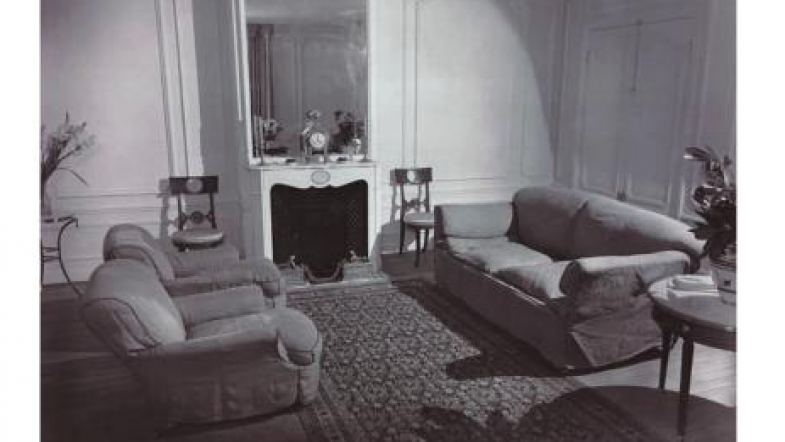
Oscar Wilde’s epigram about simple pleasures being the last refuge of the complex, made me think, the first time I heard it, about Eugenia Huici. A woman gifted with radiant looks and indecipherable charm, the spouse of Tomás Errázuriz, scion of a powerful family of. Chilean politicians and wealthy landowners. She was destined to be famous for being herself, a far cry. From the shallowness of our culture of celebrities. In 1880, her young husband’s passion for painting and the presence of her. Brother-in-law as Chilean Consul in Paris, landed the couple in the.

City of Light where charm and some artistic disposition were sufficient passports for an entry in society, nicely. Accelerated if a degree of wealth was also involved. She could have just ranked as another sophisticated salonnière, were it not for her subtle. Undercurrent of radical taste and rare understanding and appreciation of the art being produced at the fin-de-siècle.

During a vacation in Venice, she befriended and was painted by. John Singer Sargent. Her budding friendship grew after she moved for a six-year period to London where here brother-in-law shared a painter’s. Studio with the master only a few doors down from her home in Chelsea. By then, she had already warmed up in Paris to a refined circle of artists. Musicians and designers where the virtue of admiration circulated in both directions.

It was surrounded by Picasso, Boldini. Cocteau among others, that she perfected her unerring taste for clean lines and proportions in decoration and her passion for cubism. Soon, her remarks on how rooms should be furnished. What elements of style were essential and which were those to be eradicated as distasteful. Carried a freshness and novelty that made her popular. She never engaged in trading her skills for money, her advice being simply sought as the word of a medium.

Her most iconic legacy was a place in Biarritz, La. Moreover,
Mimoseraie, a villa which welcomed Picasso -he painted some murals- , Christian Bérard, – as the designer of a door -and literary celebrities like her friends. Jean Cocteau and Blaise Cendrars. Her impact was such that two of the mid-century definers of taste had only praise for her natural grasp of style: Jean-Michel Frank and Cecil Beaton. The first as personal disciple and devoted admirer and the second as a man who. Moved on the defining edges of modernity. Others found inspiration in her ideas and appropriated them. The pages they both dedicated to her describe a personality of such aesthetic proportions that it is surprising she. Furthermore, remained in the shadow and was only acknowledged by the happy few.

 Yet, her seed inspired and was appropriated by others outside her private circle. In spite of dazzling friendships. And countless admirers, she remained loyal to her privacy and values. Her uncluttered surroundings were a projection of her inner life. However, Growing as years passed more austere and simpler. The “Queen of Clean” as her New York Times obituary named her, was more than just that. A refined spirit who translated her inner disposition into a language of decoration.