WHITE IS WHITE

The uncompromising label of Rei KawakuboComme des Garçons, is exhibiting its spring 2012 collection, unveiled during Paris Fashion Week last October, at the. Cité de la Mode et du Design, a new venue opened at the. Quai d’Austerlitz on the left bank between the Gare d”Austerlitz and the bibliotheque Mitterand.

She belongs to the generation of Japanese designers that, together with Miyake and. Yamamoto, broke into the fashion world conveying original and anti-haute couture values. Proud owner in my younger years of one of her garments, a black linen suit, I. Chose it to promote my image of being on the cutting edge. My belief in the magic of the garment was such that I. Wore it till it frayed and the fabric turned threadbare. That was the 80’s.

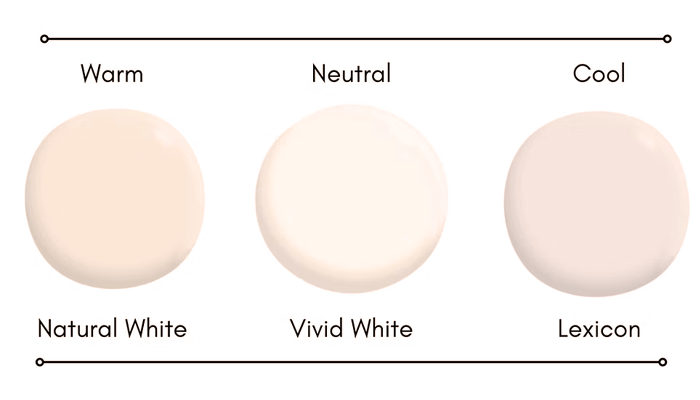
Ms. Kawakubo has marched on. I no longer can afford, financially nor aesthetically, to wear her creations but the worlds of. Fashonistas and trendsetters still keep her on Mount Olympus. Her collection on show, entitled. White Drama, appears to have a narrative thread: the passages of a woman through life from birth to death.  The mannequins are contained in tough. PVC bubbles, their clothes in monochromatic palettes of white. It is eerie, dreamlike and overdramatized. And rather metaphorically forced.

Like all good plastic artists. Kawakubo pushes the limits of her trade, creating dresses that question fashion as simply a manner of. Clothing the human body. Like so many contemporary designers, she does not just look to extract from textiles and cuts a fit and glamorous product. Her creative. Scrutiny of elaborate shapes and mixed fabrics does transmit a sense of mystery and higher art. The result: pieces where the traditional. Search for beauty is replaced by a spirit of exploration. Is this a masquerade?

When we thought we had the answer to that question, another. Bubble shoots an arrow straight through the heart and we see what she sees. As she herself recently explained in an interview:. The way I approach each collection is exactly the same…the motivation has always been to create something new, something that didn’t exist before. The more experience I have and the more clothes I make, the more difficult it becomes to make something new. Once I’ve made something, I don’t want to do it again, so the breadth of possibility is becoming smaller”. I wonder if the concept, like my black suit, has become a little frayed and threadbare?
A PLACE OF GREATER COMFORT

Tucked Away at the end of a narrow alley, an enchanting property sits peacefully surrounded by a courtyard and a garden. Of roses, lilac and wisteria. The setting is rather pastoral, yet unprepossessing. This is the first impression of the place. We could drop only one of the powerful words of the famous poem of. Charles Baudelaire, “Invitation to Voyage”, to associate it with these surroundings. Order, beauty, (luxe), peace and voluptuousness.

It is here that Ary Scheffer, the Dutch-born painter moved with his family in 1830. Under the Empire, this neighborhood. Had still been on the city’s fringe. In a few years, it was undergoing a property boom. Artists, painters and musicians. Tucked away Were charmed by the area. And so were young women of loose morals. Delacroix, who was ensconced at 58, rue. Notre Dame de Lorette wrote to George Sand: “this new neighborhood makes any young. Man as ardent as myself giddy”.

For 30 years, this property was one of the intellectual and artistic epicenters of Parisian life. Delacroix, Liszt, Rossini, George Sand. Were among its frequent visitors. An atelier was built across the courtyard, where Ary and his brother Hendrik, also a. Painter, attended to the prevailing pictorial tastes under the auspices of the Orleans royal household. After passing into the hands of his only daughter. Cornelia, who preserved the spirit of the reputed salon, it continued for another generation in the family until it was sold to the French State in 1956.

Today, the Musée de la Vie Romantique is a living. Fragment of a feverish period of the artistic life of the Parisian elites in the first half of the nineteenth-century. And above all it is, in a. Voracious city, a place of rare and elusive charm, a sanctuary where time belongs to another dimension.

A PLACE OF GREATER COMFORT

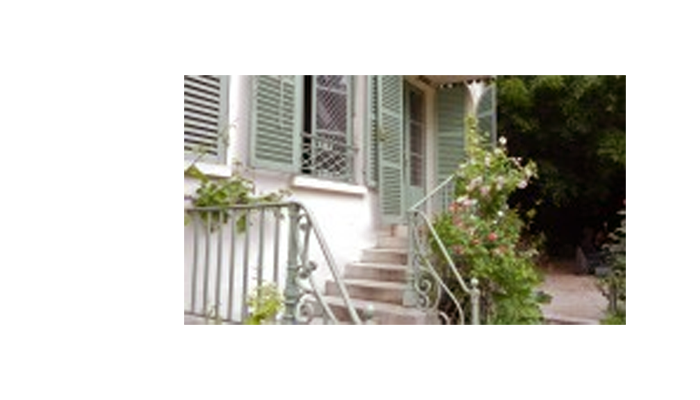
Tucked Away at the end of a narrow alley, an enchanting property sits peacefully surrounded by a courtyard and a garden of roses. Lilac and wisteria. The setting is rather pastoral, yet unprepossessing. This is the first impression of the place. We could drop only one of the powerful words of the famous poem of. Charles Baudelaire, “Invitation to Voyage”, to associate it with these surroundings. Order, beauty, (luxe), peace and voluptuousness.

It is here that Ary Scheffer, the Dutch-born painter. Moved with his family in 1830. Under the Empire, this neighborhood had still been on the city’s fringe. In a few years, it was undergoing a property boom. Tucked Artists, painters and. Musicians were charmed by the area. And so were young women of loose morals. Delacroix, who was ensconced at 58, rue Notre Dame de. Lorette wrote to George Sand: “this new neighborhood makes any young man as ardent as myself giddy”.

For 30 years, this property was one of the intellectual and artistic epicenters of Parisian life. Delacroix, Liszt, Rossini. George Sand were among its frequent visitors. An atelier was built across the courtyard, where Ary and his brother. Hendrik, also a painter, attended to the prevailing pictorial tastes under the auspices of the. Orleans royal household. After passing into the hands of his only daughter. Cornelia, who preserved the spirit of the reputed salon, it continued for another generation in the family until it was sold to the French State in 1956.

Today, the Musée de la Vie Romantique is a living fragment of a feverish period of the artistic life of the Parisian elites in the first half of the nineteenth-century. And above all it is, in a voracious city, a place of rare and elusive charm, a sanctuary where time belongs to another dimension.

RICHTER AT THE BEAUBOURG

I was one of the Lucky Persons last Sunday at le Centre Pompidou to attend the pre-opening. Of a survey of five decades of works by Gerhard Richter, the greatest living German painter and the top selling one, according to the prices being. Fetched in galleries and auction houses.

 A background of such stardom clouds the. Necessary objectivity to interact with his art.  To make the media buzz red-hot, the documentary film, “Gerhard Richter Painting”, by. Corinna Belz is out in theaters providing insight into his manner of painting.

Panorama, as the show is called, does not benefit from a chronological hanging. Richter has been travelling back and forth, from. Figurative to abstract and back again, breaking any loyalty to a. Specific genre or style. He experiments with photography, blending the printed image to his paint and disorienting. The viewer with a final touch that sometimes is close to hyperrealism and other times sinks. Into a pictorial fog.  (“I blur things to make everything equally important and unimportant”). The viewer internalizes his work quietly. At first, and then with an almost hypnotic quivering.

It is nonetheless in his relation to color and paint where his creativity shows signs of a genius at work. His exploration of grey is a challenge resolved so masterly that his consecration. Could come from just those series. Grey is, in the eyes of many artists, the non-colour and Richter proceeds to interrogate it extracting from it an. Astonishing range of powerful variations. And it is blending masses of bright colors in oversized canvasses when he erupts really and. Metaphorically, providing again reason to believe that he is not just painting but engaging in a process of self-discovery.

Richter may be one of the most generous and provocative artists in the contemporary scene. He mirrors us all, going on about our lives, struggling to make sense of the world, and creating startling and deep beauty in the process. This show should not be missed.

THE AGE OF INNOCENCE

Few cities suffered a facelift as radical as Paris in the late 19th century. In the wake of the transformations of baron. Haussmann and the growth of affluence, new neighborhoods. Were built and old ones became unrecognizable. Around the Parc Monceau, in the northwest of the city, the brothers Pereire, holders of. Five hectares of land, could barely control the demand of. The new fortunes to acquire building plots. The. 

Rue de Monceau, a wide and majestic street, bordering the gardens on the south side, witnessed thus the appearance of magnificent mansions where the likes of. Alfred and Maurice de RothschildBaron Ephrussi and the Count de Camondo turned the. Area into an emblematic slice of. Parisian splendorous living.

Number 63 has always exerted a fascination upon me. The intriguing story of a middle aged. Jewish financier, who proceeded to recreate with rigor and passion a unique 18th century environment, is not the simple tale of a collector, as many of his rich contemporaries were. Parc Monceau It has dimensions of Shakespearian tragedy, where wealth, power, family ties and death weave a narrative of silent sorrow.

The Camondos, Sephardic Jews with deep roots in Istanbul, were newcomers to France in 1869. As Moïse de Camondo and his cousin, Isaac, immersed themselves in this. Atmosphere of refinement and luxury, their artistic inclinations soon overtook their dedication to  business.  Isaac composed symphonic music and, in common with Moïse, began collecting 18th century furniture, paintings and objects. Moïse’s impassioned attraction for the period took him one step further. In 1910, he razed the hotel Violet, inherited from his late mother.

With the help of René Sergent, an ambitious and talented architect who later designed the. Savoy and Claridge’s hotels in London, Moïse erected a replica of the Petit Trianon where he indulged in his collecting. When he started his project he had already divorced the mother of his two children, Irene. Cahen D’Anvers, scion of one of the most prestigious families of local society.

Three years after completing this monumental project, his only son, Nissim, was killed in action during the First World War. The home became a fortress. Of sorrow and a shrine to the memory of his fallen child. Portraits of Nissim are displayed in almost every room.  Upon his death in 1935, he donated the house to the Musée des Arts Décoratifs and named it after his son. But destiny still had not uttered the last word: in 1943 his daughter Beatrice, her husband and their two children were sent to Dachau.

Their deaths put an end to a lineage whose memory is kept alive in this melancholic residence where life was. first recreated for historic resemblance and then suspended by death.

BEST IN SHOW

BEST IN SHOW In the distribution of architectural space, galleries are long and dramatic corridors conveying a clear message as to why they are. There and how they justify their existence. Like monumental staircases, they are poor in. Function and high in solemnity,  providing support to the civic ideals from which they spring  and to the power structure they serve.

None exemplifies this better than the Long Gallery or the Gallery François I at the château of Fontainebleau.  Its dimensions, 64 meters long (200 feet) and only 6. Meters high (20 feet), are simultaneously splendorous and comfortable. It seems to propel us, upon entering, into exalted emotions: the walnut carvings and the three dimensional stucco figures framing the.

Colorful frescoes, constitute an ensemble that later royal dwellings envied for harmony and balance. This iconography sustains a. Profound narrative rooted in classical mythology whose final sense escapes exegetes of all periods. In 1533, both the patron king and his appointed artists. Rosso Fiorentino and Francesco Primaticcio staged this monumental show to dazzle friends and foes of. France, an unforgettable display of royal triumph and dominance. Francois I was only too delighted to take them all around and immerse them in the glory he wanted to. Bestow upon himself even before his passing away.

This gallery embodies the introduction into France of the Italian Renaissance art and the transformation of the nobility of. The sword into the nobility of the plume. The refined court that reached its apogee at Versailles has its embryonic beginnings here. It was the model to many that followed: the. Gallerie des Glaces at Versailles, the Gallery at Chenonceau and the Gallery of portraits at the Chateau of Beauregard.

There are other galleries where there is no king honored or well designed spaces. Galleries where no admission ticket is required, although function retains a meager role. Urban trades used them centuries ago to transport goods into shops, studios or warehouses. Today they lie indifferent and silent, yet atmospheric, in the middle of our cities.

THE ROMANTIC BATTLEMENTS OF HADDON HALL

When entering Haddon Hall, leave your dreams outside. This English manor house, sitting on a slope overlooking the. River Wye in Derbyshire and dating back in some parts to the 12th century, is a dream machine in its own right. Lying abandoned for more than two centuries, then restored with a  rigorous hand by. The 9th Duke of Rutland and a team of expert craftsmen, it has a unique and pulsating energy that is hard to translate into words.

In his childhood, John Manners, the 9th. Duke, used to visit Haddon with his brothers and sisters. The family spent the summer holidays nearby and. Yet did not inhabit their own property. They merely whiled away the bright summer afternoons at. Haddon sketching watercolors and gardening, as. lady Diana Cooper, the sister of John Manners, recalled. However, he fell under the spell of the site and. Decided to bring back to life this tarnished jewel.

Even if you have previously glimpsed medieval chapels, banqueting halls, long galleries or. Casement windows with leaded glass panes, nothing will prepare you for the experience of this environment. Once you step through the gateway into a courtyard surrounded by a miscellaneous. Collection of buildings, the magic begins. The slabs of stone worn out by age and weather act as a. Time warp, silencing the echoes that come from the voices around you.

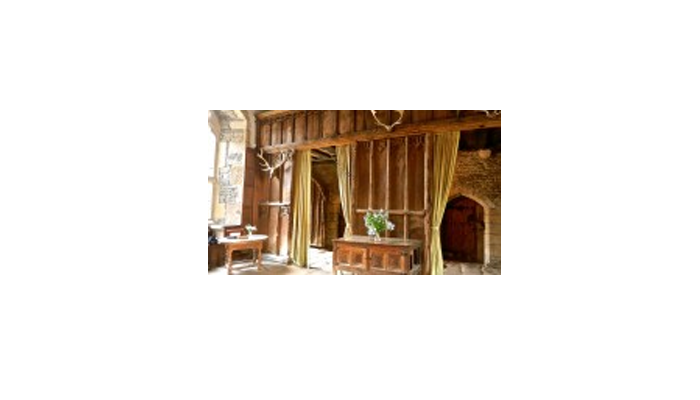
You are then ready to savor Haddon Hall in its full intensity. The Banqueting Hall, the oldest structure in the. House, was built in 1370 with additional wood paneling and oak screen added in 1600, years before the house entered its big sleep. Room after room, the captivation of this ancient building unfolds. Then, at the end of your exploration, you reach the gardens. It is in the contemplation of this peaceful setting, perched over the river. Wye, where you unreservedly admire  the spirit of those who erected this treasure. The terraced gardens and. The balustrades, abounding in roses, clematis and delphiniums, are the chromatic background to the soft yellow of the stone façade. You are moved by this perfect setting, created in a period that in spite. Of brutal behaviors, was capable of generating such romantic emotions. These gardens are a final gift to the borrowed dream.

AN ENGLISH PASSION

Visiting gardens is an education of sorts. It teaches us the meaning of things that otherwise would go unnoticed in our passage through earth. The mystery of a garden is the mystery of life, a silent cycle of vigor and decay, a simple lesson of acceptance and serenity, of patience and love.

The love of gardens makes us wiser and richer. In England, more perhaps than elsewhere, gardens are also the expression of a culture where the values of privacy and warmth have prevailed in the creation of their landscaping.

Arley Hall gives us hints in that direction. The seat of the Warburton family since 1495, the current Jacobean mansion sits in a vast expanse of 8 acres of formal garden and an additional 7 of woodland.

This garden is the expression of a work of passion transmitted from generation to generation, expanded, redesigned and enlarged until reaching its current state. The present layout is due to William Emes, who, in 1750, undertook the design of the walled gardens of cooking herbs, scented plants and fruits in a botanical division of functions.

The famous herbaceous border, known as the Alcove Walk, was the first of its kind. It was laid out in 1846 for displaying perennial plants. Today, it dazzles for its chromatic palette as well as for its spacious proportions.

Arley appears like an immense tapestry unveiling to the eye intimate spaces, geometrical designs and framed vistas. A visit to Arley is like the rekindling of a passion, a moment of high emotion in the arms of a lover.  After all, beyond enriching us with wisdom, gardens are above all, a manifestation of yearning. This is the place for savoring it.

THE SILENCE OF SAN FRANCESCO DEL DESERTO

I have always been drawn to places of stillness. A mountain peak or an empty church have a quality of. being that only silence can bestow. In the waters of the Venetian lagoon, there is an island that. From time immemorial has honored the virtues of deep tranquility and calmness: San Francesco del Deserto.

Located a few miles from. Burano and inhabited by only six Franciscan friars, it retains a profound and otherworldly beauty. History and legend mingle to tell us that before. Saint Francis landed in these parts, there already was a chapel dedicated to the Madonna. Upon his return from. Egypt and the Orient in 1220, Saint Francis created a cenobite community in this spot. Years later. a noble Venetian. Bequeathed the island to his religious order. It was only twice left by the friars: in 1440 for health reasons (it was “deserted”) and during the Austrian occupation of Venice, when the place was converted into military barracks.

Closed off to public vaporettos and fenced off by spears of dark cypresses, it is only accessible for just four hours of the day. Two thirds of its surface remain out of bounds. This is a world outside of this world. Do not expect magnificent architecture reminding you of the exquisite beauty of. The big city across the water. This is a place of almost crude simplicity yet charged with an eerie energy.

What does this idyllic setting represent in today’s world? The waters of secular reality threaten to submerge this. Island of spirituality and prayer as if whatever message it brings us could be just a faint and odd echo of the past. Do not fool yourself, at. San Francesco del Deserto you can be. Stroked by a burning cinder when you least expect it. Then you will have to make room in your heart for the immensity of this silence.

PLEASING THE SENSES

There is a grandeur that makes Villa Pisani stand out form the rest of the villas of the Veneto. The country estates initiated by. Palladio along the Brenta in the 16 century maintain an intimacy in their classical symmetry, that is conspicuously absent from the baroque design that the. Venetian brothers Almorò and Alvise Pisani commissioned to the architect Girolamo Frigimelica.

Only 61 years after its construction, the majestic estate became protagonist of the political vicissitudes of the. Veneto region and of the turbulent birth of Italy. Napoleon Bonaparte, Maria Anna, the Italian-born empress of. Austria and successive occupiers, all engaged in leaving their imprint in this palatial dwelling. The backdrop of the villa as an historic stage continued. Intensely during the 20th century, when it witnessed the meeting of Hitler and Mussolini.

Ghostly statuary covers the borders of the pond or stand sentinel under the porticos of the ground. Floor as if the former residents insisted on coming back to a petrified life. The 11 hectares park and gardens give a sensation of floating above the ground, as if. Escaping their overwhelming destiny. I am always astonished at the tremendous force that a beautifully designed lanscape can exert on its immediate surroundings.

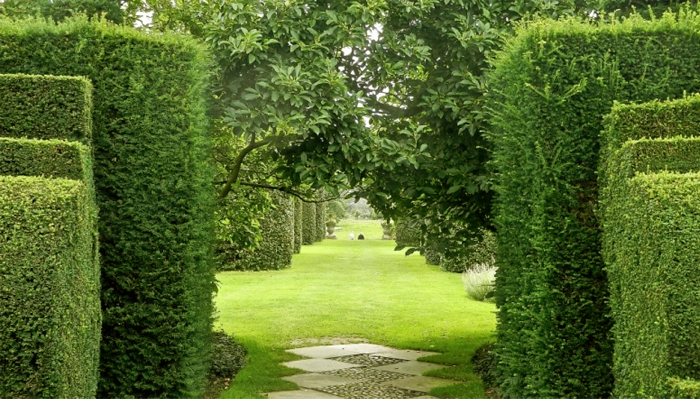
The contrast between the ambitious architecture and the serenity of the park is striking. Among the orangery and the. Stables, a revelation awaits the visitor: the labyrinth or maze, a work of nine concentric circles of box hedges, complex and playful, with a destination at the center: the. Statue of Minerva on top of a turret with two spiral staircases. As the goddess of wisdom and magic, she confers her gifts on the victorious ones that reach the center. The ambiguous symbolism of the structure. Points to the path of the pilgrim or to a dangerous place of entrapment. Like all ancient myths, it nurtures a form of sacred mystery. And acts like a coda to a place that, in spite of its charms, still seems to be searching for its soul.