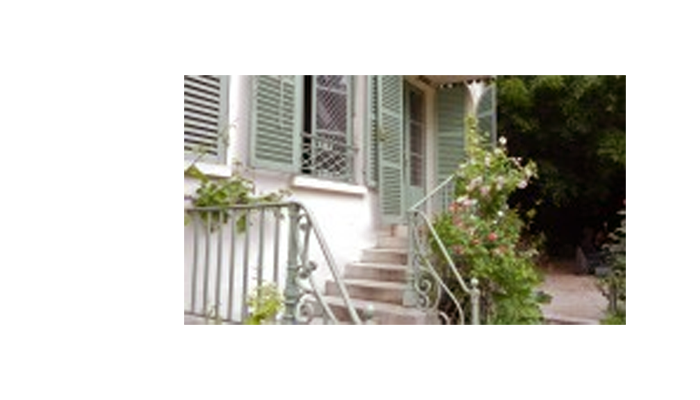
Tucked Away at the end of a narrow alley, an enchanting property sits peacefully surrounded by a courtyard and a garden. Of roses, lilac and wisteria. The setting is rather pastoral, yet unprepossessing. This is the first impression of the place. We could drop only one of the powerful words of the famous poem of. Charles Baudelaire, “Invitation to Voyage”, to associate it with these surroundings. Order, beauty, (luxe), peace and voluptuousness.
It is here that Ary Scheffer, the Dutch-born painter moved with his family in 1830. Under the Empire, this neighborhood. Had still been on the city’s fringe. In a few years, it was undergoing a property boom. Artists, painters and musicians. Tucked away Were charmed by the area. And so were young women of loose morals. Delacroix, who was ensconced at 58, rue. Notre Dame de Lorette wrote to George Sand: “this new neighborhood makes any young. Man as ardent as myself giddy”.
For 30 years, this property was one of the intellectual and artistic epicenters of Parisian life. Delacroix, Liszt, Rossini, George Sand. Were among its frequent visitors. An atelier was built across the courtyard, where Ary and his brother Hendrik, also a. Painter, attended to the prevailing pictorial tastes under the auspices of the Orleans royal household. After passing into the hands of his only daughter. Cornelia, who preserved the spirit of the reputed salon, it continued for another generation in the family until it was sold to the French State in 1956.
Today, the Musée de la Vie Romantique is a living. Fragment of a feverish period of the artistic life of the Parisian elites in the first half of the nineteenth-century. And above all it is, in a. Voracious city, a place of rare and elusive charm, a sanctuary where time belongs to another dimension.